A shopper types “gooseneck ketle”. Or asks a question. Or searches for something you never wrote in a product title. Most store search returns nothing, and they leave. SearchSmith runs keyword and meaning together on every query, answers questions from your own guides with citations you can check, and, when two products fit the query about equally well, puts the one that earns you more gross profit first.
Running on a live 24,875-product store since Aug 24, 2026 — and on a public demo whose merchant console is open with no sign-in.
Products open the full demo store in a new tab · Browse the whole store →
Most store search does one thing: it looks for your words in the product title. That is why a typo, a question, or a shopper's own phrasing returns an empty page. SearchSmith runs three lanes at once.
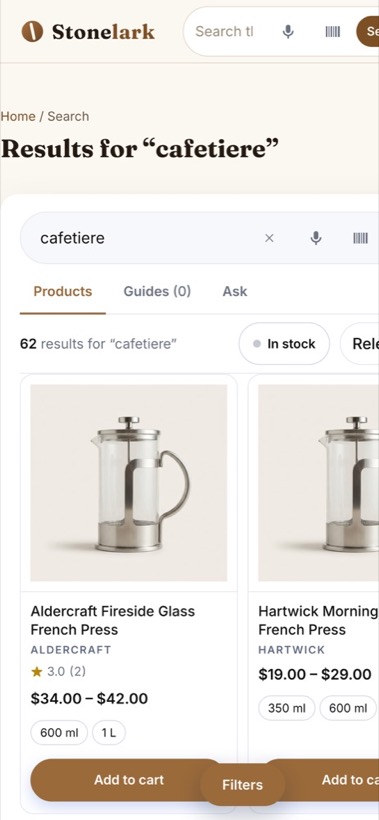
Tiered full-text matching with typo tolerance and did-you-mean correction, so “ketle” still finds the kettles and “expresso” still finds the espresso machines.
An embedding model that understands intent, so “something to make coffee while camping” returns the travel grinder and the basecamp kettle — none of which contain the word “camping”.
A SKU and barcode exact-match lane that pins the precise product when someone types a code, or scans one with a phone camera.
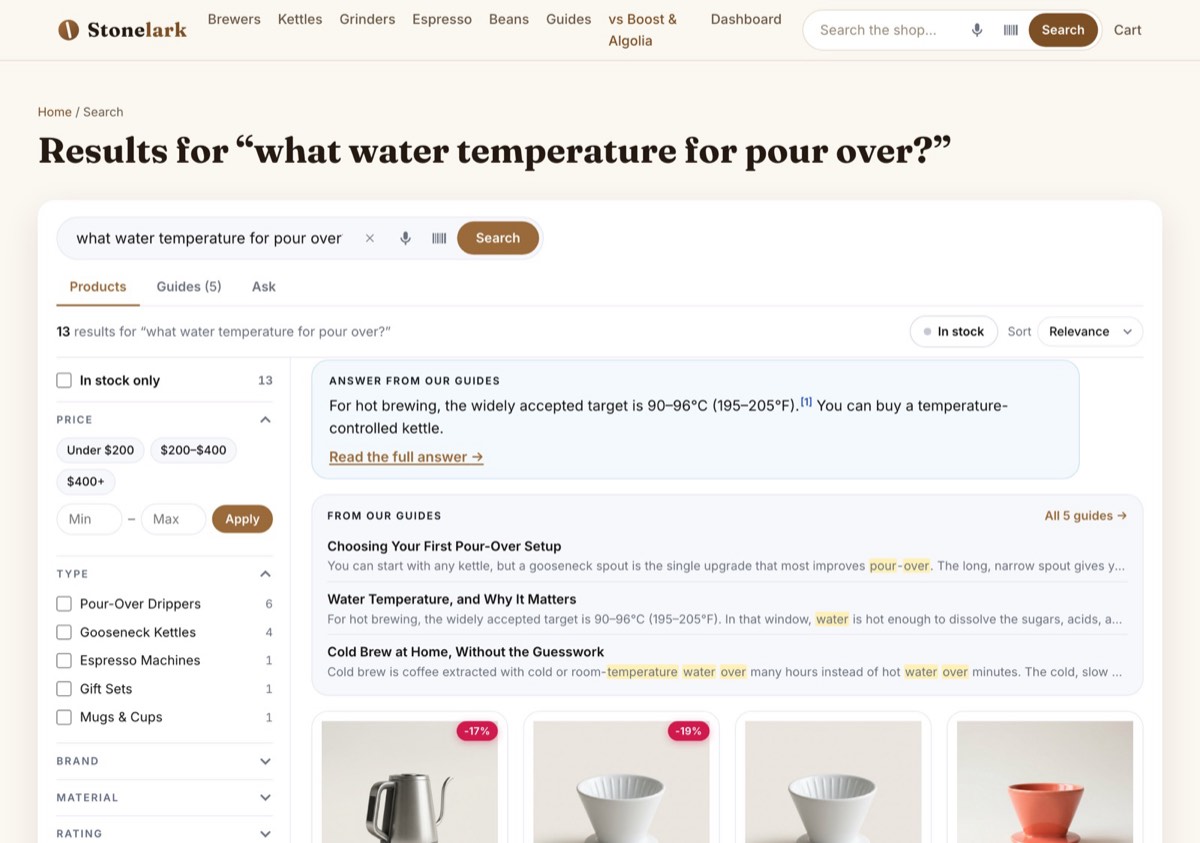
Shoppers ask questions in the search box whether or not you built for it. SearchSmith answers from your own guides and policy pages — never from the open internet — and every sentence carries a numbered citation.
The citation is machine-checked: a marker survives only if its sentence genuinely overlaps the passage it cites. Anything that cannot be traced back to one of your pages is deleted before the shopper sees it. If nothing on your site covers the question, it says so instead of guessing.
That proves traceability to a source — not that the source is right. Your guides are still your guides.
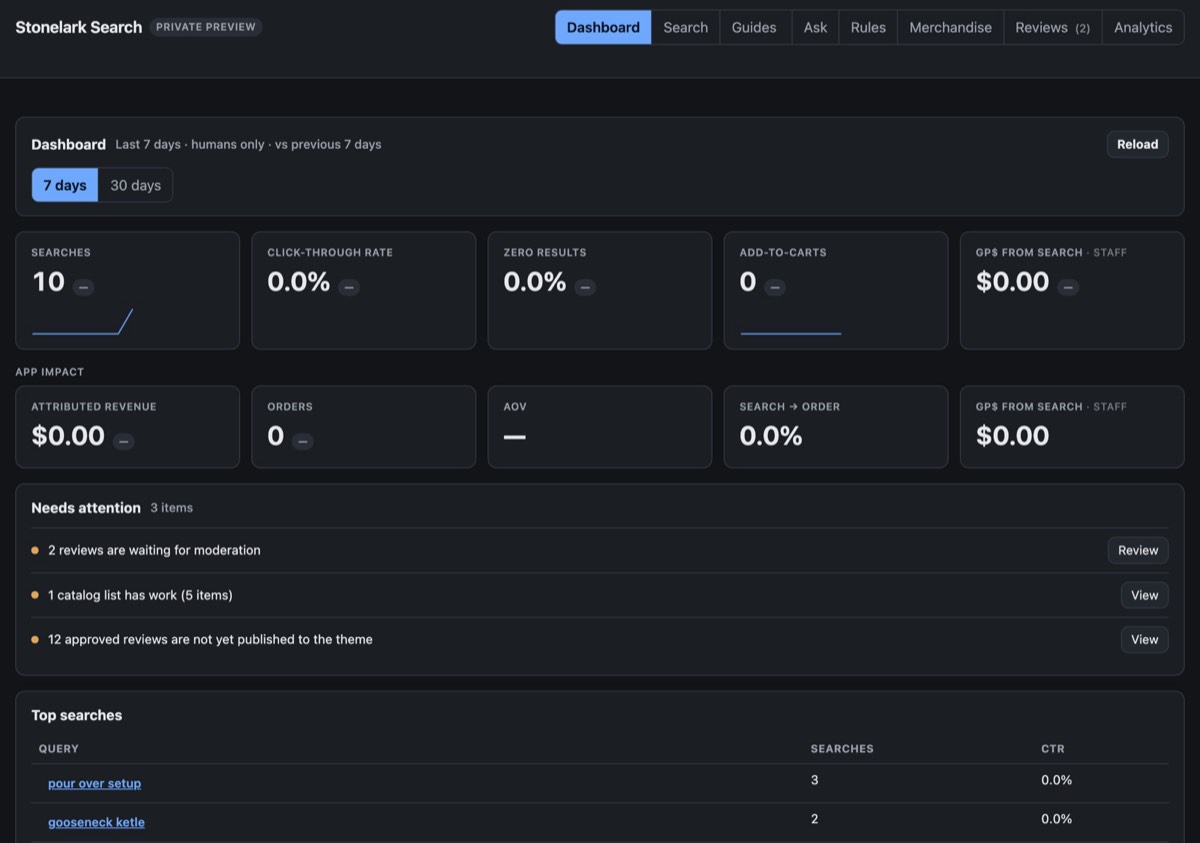
On the production store, 73% of sessions are bots. Every number in this console is labelled humans only and computed behind that filter — so the search volume and click rate you are reading are the ones actual customers produced, and the analytics tab prints the bot share so you can see what was excluded.
Underneath: merchandising rules and campaigns, A/B tests with a real significance test that refuses to show a verdict under thirty searches per arm, synonyms, review moderation, and a queue of the searches that found nothing — each one a rule you can fix in a click.
The demo's console is open to anyone, no account. Break it; it resets every six hours.
The code a shopper's phone downloads before search appears is 7,509 bytes gzipped. The app it replaced on the same store served 102,571 bytes, measured the same way — thirteen times more.
That budget is enforced as step zero of every deploy: if the loader grows past its ceiling, the build fails and nothing ships. Search is the first thing a shopper touches on a phone, and it should not be the heaviest.
Every one of these is reproducible, and the comparison page names how each was measured and when.
There is no tier here to be on the wrong side of. Every capability below runs in every deployment.
Meaning and keywords on every query, with typo tolerance and did-you-mean correction.
Equally relevant products ordered by gross profit dollars, inside a strict band, fully auditable.
Shopper questions answered from your guides, every sentence footnoted and machine-checked.
Sold-out products sink, in-stock leads page one, and a back-in-stock bell replaces the dead end.
Pin, boost, bury, hide, schedule — plus banners, all editable without touching your theme.
Two-proportion z-test with a significance flag, blank until there is enough traffic to mean anything.
A configurable filter rail and search inside any collection — at no tier, in every deployment.
Scan a barcode into the exact-match lane, or speak a query. No camera frame ever leaves the device.
No admin token, no API key, no access to your orders. Public-page crawls every 20 minutes.
A version that ranks worse than the last one is rejected automatically, before it reaches a shopper.
As of August 2026 there is no listing, so there is no one-click install and no Shopify-native billing. Today the engine installs by Shopify custom distribution — a single store, or one Plus organisation — and billing is direct. A listed app is roughly six months of full-time build.
Boost has been listed since January 2017, with 4.8 stars across roughly 1,500 reviews and a Built for Shopify badge. If you need search installed and working this week and never thought about again, that is a real advantage and it is theirs.
We also do not send back-in-stock emails (we capture the demand and hand it to your email platform), we speak English only, we have none of the thirty-plus app integrations Boost ships, and we publish no status page or SLA — and will not claim one until there is a contract behind it.
Support is one person — the person who wrote the ranker, but one person, not a team with a rota. There is one production store behind these numbers, not a thousand. And the price is not set yet, so you cannot compare it to the $29 you are being quoted elsewhere.
The full comparison, including twelve things they do better →
No. As of August 2026 it is not listed. The engine runs in production on one live 24,875-product store and on a public demo store. It installs today only by Shopify custom distribution, which is limited to a single store or one Plus organisation and cannot bill through Shopify.
The first-paint payload is 7,509 bytes gzipped — 6,696 bytes of JavaScript plus 813 of CSS. Measured the same way on the same store, the app it replaced served 102,571 bytes. A size budget is enforced as step zero of every deploy, so the build fails if the loader grows.
No. It runs with no store credentials at all — no admin token, no API key, no permission to read your orders. Stock, prices and collections come from crawls of pages that are already public, every 20 minutes. A compromise of us cannot leak a token we were never given.
Yes — the demo above is the real engine, and the whole demo store plus its merchant console is open with no sign-in and no account. Everything you change there resets automatically every six hours.
Pricing is not published yet. The intent is to price by catalogue size rather than by your revenue, so the bill does not rise because you had a good quarter — but that is stated intent, not a live price sheet, and we would rather say so than invent a number.
The demo store and its merchant console are open — no sign-in, no email.
Misspell something, ask it a question, pin a product, read the live A/B test.
Send your store URL and I will run your own catalogue and your last 90 days of search terms through it, and show you what changes — before you commit to anything.